Special Frontier Force Independent Security & Protection

+91 97699 99960 im@digantsharma.com

Confidential Enquiry
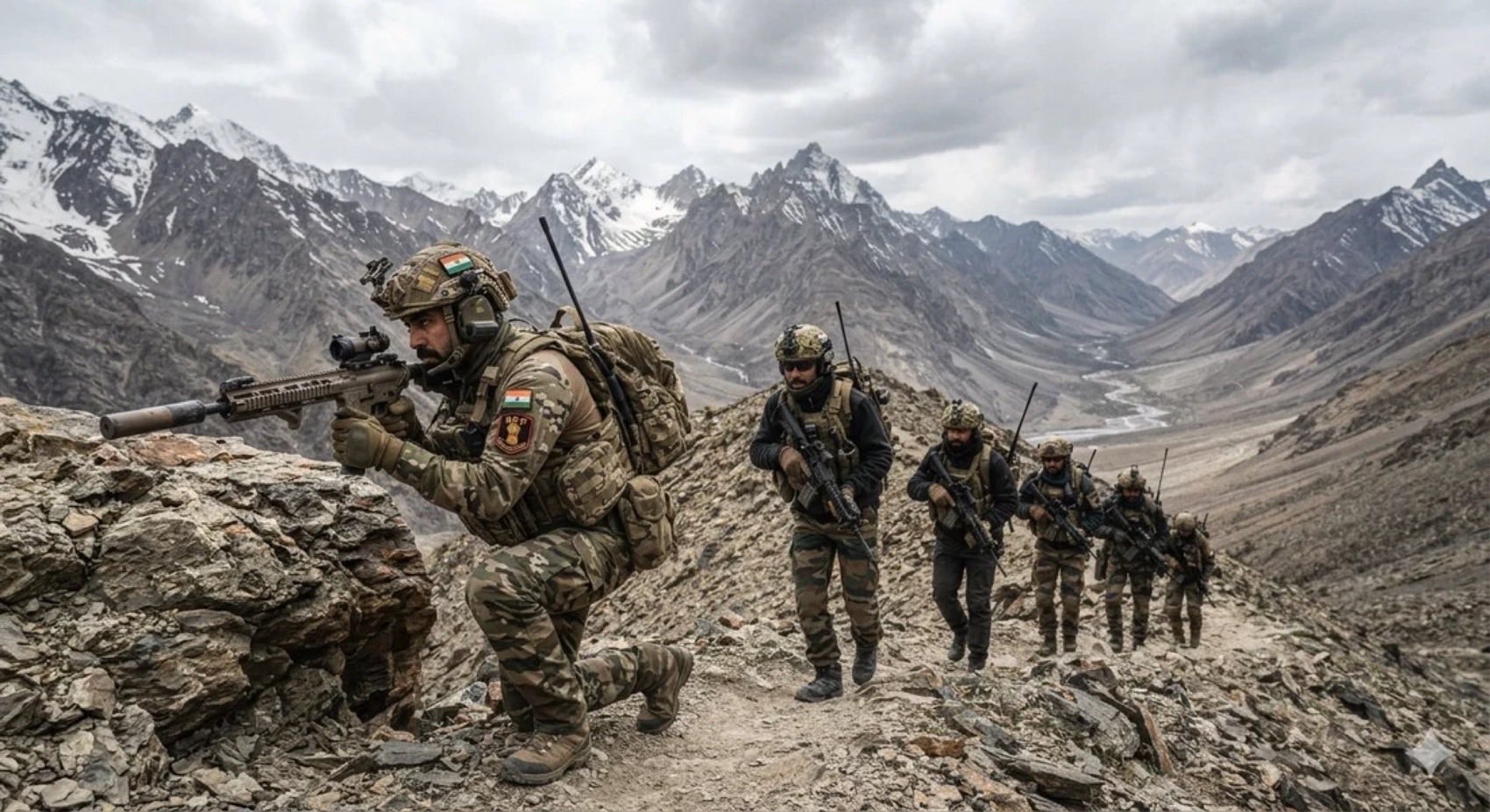
Personnel in protective equipment moving in single file along a high-altitude ridge beneath snow-covered peaks.

Independent Security & Protection

Discipline. Experience. Protection.

Independent security specialists bringing professional experience, structured preparation and disciplined protection to complex security requirements.

We work with appropriately qualified former military, special-operations, protective-security and specialist personnel where legally permitted, delivering security solutions built around preparation, discretion and accountability.

Independent International Security Organisation

02 Philosophy Prevention · Preparation · Proportion

Security begins
before the threat

Professional protection is not simply physical presence. Presence is the most visible part of security work and the least significant part of it. What determines an outcome is almost always decided earlier — in what was understood, anticipated and prepared for.

A protective arrangement that depends on reacting well has already accepted more risk than it needed to. Our work therefore begins with understanding rather than deployment: the environment a client operates in, the way they actually live and work, and where ordinary routine creates predictable exposure.

That understanding is built deliberately and without assumption. Two clients in the same city, the same industry and the same apparent risk profile frequently require entirely different arrangements, because their circumstances, obligations and tolerances differ. Security that is copied from a template protects the template.

Understanding precedes protection

  • The environment — the conditions, infrastructure and local realities in which an assignment takes place.
  • The client's circumstances — commitments, working patterns, family considerations and public profile.
  • Relevant risks — what is credible and material, separated carefully from what is merely conceivable.
  • Potential vulnerabilities — points at which routine, information or access create avoidable exposure.
  • Movement patterns — how, when and why the client travels, and what can sensibly be varied.
  • Communication requirements — who needs to know what, how quickly, and through which channel.
  • Contingency planning — what happens if a plan cannot be followed, and who decides.
  • Legal constraints — the laws, licences and permissions that define what may lawfully be done.
Abstract topographic contour study: concentric survey lines describing rising ground, used here as a design motif for structured assessment. Assessment before action
Survey study — decorative Fig. 02

Prevention and preparedness

Prevention is inexpensive compared with response, and almost always less disruptive. Most of what protects a client is quiet: a route reconsidered, a schedule that is not published, a venue understood in advance, an arrival arranged so that it is unremarkable.

Preparedness is what remains when prevention is not enough. It is the difference between people improvising under pressure and people carrying out something they have already thought through, with agreed roles, agreed thresholds and an agreed way of communicating.

03 The Frontier Mindset Professional qualities

Built for complex environments

Demanding environments do not reward improvisation. They reward people who have prepared, who understand their responsibilities precisely, and who behave the same way on a difficult day as on an ordinary one.

The qualities below are professional characteristics rather than techniques. They describe how competent security personnel work — the standard by which we assess the people we engage and the arrangements we design. We do not publish operational tactics, procedures or methods on this website.

A dark massif rising through layered haze, an abstract illustration of sustained effort in demanding conditions.
Composure under load Fig. 03
Q.01

Discipline

Following established procedures and responsibilities consistently, including when nothing appears to require it. Discipline is what makes conduct predictable to colleagues and to clients, and it is the quality that degrades last under pressure.

Q.02

Adaptability

Remaining effective when circumstances change. Schedules move, venues alter, conditions deteriorate. Adaptability is the capacity to adjust to what has actually happened without abandoning the plan's intent or exceeding agreed authority.

Q.03

Awareness

Understanding the environment and recognising potential risks early enough for a measured response. Awareness is disciplined attention — knowing what normal looks like in a given place, so that a departure from it registers.

Q.04

Composure

Maintaining professional decision-making under pressure. Composure is not an absence of concern; it is the ability to keep thinking clearly, communicate accurately and act within scope when a situation becomes uncertain or urgent.

Q.05

Teamwork

Working within defined responsibilities and communication structures. Effective security is rarely the work of one person. It depends on people who know their role, know the roles of others, and pass information accurately and without delay.

Q.06

Responsibility

Operating within law, contract and professional standards at all times. Responsibility includes knowing the limits of one's authority in a given jurisdiction and declining to act beyond them, whatever the circumstances appear to justify.

04 Security Capabilities Six core areas

What we do

Our capabilities are organised around a single principle: security should support a client's activity, not replace it. Each area below is delivered within the legal authority and professional scope applicable to the assignment, and each is available only where local law, licensing and work authorisation permit.

Availability, scope and structure are confirmed assignment by assignment following an initial assessment. No engagement is accepted on the basis of a website description alone.

Full Service Architecture

Two deeper capability pages

Every capability is confirmed against local law, licensing and work authorisation before it is offered. Where a requirement cannot be met lawfully or to an acceptable standard, we will say so.

05 The Five-Stage Method How an engagement is built

A method, not a reaction

Every engagement follows the same sequence, whatever its size. The sequence is what makes the work reviewable: each stage produces something the client can see, question and approve before the next begins.

  1. 01

    Understand

    Understand the client's environment and requirements — what they do, where they do it, what must continue uninterrupted, and what they are trying to protect.

  2. 02

    Assess

    Identify relevant risks and vulnerabilities, and assess each for likelihood and consequence so that attention goes where it is actually warranted.

  3. 03

    Prepare

    Develop an appropriate security framework: measures, responsibilities, communication, thresholds and contingencies, agreed in writing with the client.

  4. 04

    Protect

    Implement the agreed protective measures within legal scope, proportionate to the assessment and designed to remain as unobtrusive as the circumstances allow.

  5. 05

    Review

    Evaluate and improve the approach. Circumstances change; an arrangement that is never reviewed slowly stops matching the situation it was designed for.

Each stage is documented, agreed and reviewable. Nothing proceeds on assumption.

06 — Experience & Accountability

Experience matters.
Accountability matters more.

Relevant professional experience is valuable, and we look for it. People who have worked in demanding, structured environments frequently bring qualities that are difficult to teach quickly.

Sustained service in a disciplined profession can develop composure under pressure, a habit of preparation, an instinct for accurate communication, and the ability to work inside a defined role without needing to be managed. These are real advantages in protective work, and they are part of why we look to experienced professionals.

But experience alone is not a qualification, and a background is not a credential. Experience gained in one legal context does not transfer automatically to another, and an impressive history says nothing about a person's current licensing, current authorisation to work, or current professional conduct.

For that reason, background is where assessment starts rather than where it ends. What an individual has done matters less to a client than whether their participation is verified, lawful, insured, contracted and accountable today, in the jurisdiction where the work will take place.

What experience can contribute

  • Discipline — consistent conduct under routine and pressure alike
  • Situational awareness — early recognition of what has changed
  • Structured decision-making — sequence and priority under time constraint
  • Teamwork — reliable performance inside a defined role
  • Preparedness — planning treated as ordinary rather than exceptional
  • Professional composure — accurate communication when it is difficult

What experience does not replace

Qualifications, legal compliance, background verification and professional accountability are equally important — and in practice they are what a client is actually relying on. Previous government or military service does not confer current government authority. All personnel operate only within the legal authority and professional scope applicable to their assignment.

Read our standards & compliance position

07 International Outlook Assignment by assignment

A stylised graticule sphere with latitude and longitude lines and an abstract point field — a decorative representation of international outlook, not a map of operations.
Graticule study — decorative Fig. 07

International in outlook.
Local in compliance.

Security work does not travel freely. What is permitted in one jurisdiction may be restricted, licensed differently, or prohibited outright in another — and the obligation to know the difference rests with the provider, not the client.

We approach international requirements with an international outlook and local compliance. Every assignment outside a specialist's home jurisdiction is assessed on its own terms before any commitment is made, and we will say plainly when a requirement cannot be met lawfully or to an acceptable standard.

C.01

Local law

What protective activity is lawful, by whom, and under what conditions.

C.02

Licensing

Whether the work requires a licence, and whether it can be lawfully obtained.

C.03

Work authorisation

Whether personnel may lawfully perform paid work in the jurisdiction.

C.04

Insurance

Whether appropriate cover is available and valid for the activity and territory.

C.05

Immigration

Visa category, duration and conditions attaching to entry and stay.

C.06

Contract

Governing law, scope, liability, data handling and termination terms.

C.07

Local partners

Whether licensed local providers are required, and how they are selected.

C.08

Cultural context

Local expectations and conventions that affect how work should be conducted.

International capability is assessed assignment by assignment.

International Security

08 Why Special Frontier Force Six commitments

What a client is actually choosing

Security is bought on trust, often before there is any evidence to justify it. These six commitments describe what that trust rests on with us — and they are the terms on which we expect to be judged.

W.01

Discipline

Professional standards guide every engagement, from the first conversation to the final review. Conduct does not vary with the size of the assignment or the seniority of the client.

W.02

Experience

Relevant backgrounds can provide valuable perspective — judgement developed in demanding conditions, and a working familiarity with structure, preparation and accountability.

W.03

Discretion

Protection should support the client's activities, not overshadow them. In most engagements the measure of success is that nothing about the arrangement was noticeable.

W.04

Preparation

Planning reduces uncertainty. Time spent understanding a requirement in advance consistently produces better outcomes than resources added once a situation is already difficult.

W.05

Compliance

Every assignment must respect applicable law, licensing and contractual conditions. Where an approach cannot be delivered lawfully, we say so rather than proceed.

W.06

Trust

Confidentiality and accountability are fundamental. Client information is handled on a need-to-know basis, and responsibility for conduct is never diffused.

Begin a confidential conversation

Tell us what you need to protect. We will tell you plainly what is possible.

An initial conversation is without obligation. Please send only the information necessary for a first assessment — never classified, government-restricted or operationally sensitive material.