M.1
Professional protection
Protective support for individuals, families, executives and eligible clients, designed around the client's actual pattern of life and delivered as unobtrusively as circumstances allow.
+91 97699 99960 im@digantsharma.com
Confidential EnquiryIndependent security specialists. Disciplined professionals. International perspective.
02 Who We Are Position · Purpose · Method
Special Frontier Force, as represented by this website, is an independent international security and protection organisation. We are a private organisation. We are not a government body, an armed force, a law-enforcement agency or an intelligence service, and we do not act on behalf of one.
We state this first because it is the single most important thing a prospective client, candidate or member of the public needs to understand about us. Names in the security sector can carry associations that a private organisation has no right to borrow. Where our name invites such an association, the association is not claimed here and should not be inferred.
What we do claim is narrower and more useful: that we work with appropriately qualified former military, special-operations, protective-security, law-enforcement and specialist personnel, where legally permitted, to provide disciplined, discreet and legally compliant security solutions for clients operating in complex environments.
The organisation exists because a particular kind of client is poorly served by the market. That client needs protection that is competent without being theatrical, planning that is honest about uncertainty, and a provider that will decline work it cannot deliver lawfully. Those are unglamorous commitments. They are also the ones that matter when something goes wrong.
Statement of independence
Previous government or military service does not confer current government authority. All personnel operate only within the legal authority and professional scope applicable to their assignment. Nothing on this website should be read as asserting a governmental, military, intelligence or law-enforcement mandate, rank, office or power.
What we do not do
A note on history
We do not publish a founding narrative, an institutional lineage or a record of past assignments. Organisational history is easy to write and difficult for a client to verify, and in this sector an invented history is a warning sign rather than a credential. Where a fact about this organisation is not independently verifiable, we would rather leave it unstated than assert it.
Client work is confidential in any event. A provider willing to publicise one client's arrangements has already demonstrated how it would treat yours.
03 Our Mission Why the organisation exists
To help people and organisations operate more safely and more confidently, while respecting applicable laws and professional boundaries.
Confidence is the part clients tend not to articulate. Most people do not want a security arrangement; they want to continue doing what they do — travelling, meeting, building, appearing publicly — without the quality of that work being degraded by anxiety or interruption. Good security returns attention to the client's actual purpose.
That objective sets the boundary of the mission as clearly as it sets its content. Security delivered outside the law, outside contract or outside competence does not create confidence; it creates a second problem alongside the first.
 Layered standards
What the mission covers
M.1
Protective support for individuals, families, executives and eligible clients, designed around the client's actual pattern of life and delivered as unobtrusively as circumstances allow.
M.2
Structured assessment of people, premises, movement, events and organisational arrangements, producing findings that are specific, prioritised and capable of being acted on.
M.3
Helping clients identify, assess, prioritise, mitigate and monitor security risk as a continuing discipline rather than a single document produced once and filed.
M.4
Lawful awareness, prevention, de-escalation and personal-safety instruction for individuals, families and organisations — focused on avoidance and judgement, not confrontation.
M.5
Close protective arrangements for principals whose profile, role or circumstances justify them, built on advance planning and continuity of normal business activity.
M.6
Identifying, verifying and coordinating appropriately qualified specialists for defined requirements, only where their engagement is lawful and properly contracted.
The objective is to help people and organisations operate more safely and confidently while respecting applicable laws and professional boundaries.
04 Organisational Values Eight commitments
Values are worth publishing only if they constrain behaviour when it would be easier to behave otherwise. Each of the eight below is written to describe a decision we are prepared to be held to, not an aspiration.
Doing the prepared thing, consistently, including when circumstances appear not to require it. Discipline is the habit that makes conduct predictable — and predictability is what colleagues and clients actually rely on when a situation becomes unclear.
Describing our capability accurately, including its limits. We would rather lose an engagement by saying that something is outside our competence, jurisdiction or licence than win it and discover the same fact later at a client's expense.
Protecting a client's privacy as carefully as their person. Information is handled on a need-to-know basis, arrangements are designed to attract as little attention as possible, and client identities are not used as marketing material.
Treating planning as ordinary work rather than an exceptional effort. Preparedness means the contingency was considered before it was needed, roles were agreed in advance, and nobody has to invent a procedure while under pressure.
Accepting that a security decision belongs to whoever made it. Responsibility is not diffused across a team or deferred to a policy document; individuals act within their scope and are accountable for what they did and did not do.
Treating clients, colleagues, members of the public and local counterparts with professional courtesy. Protective work frequently takes place in someone else's country, culture or premises, and conduct there reflects on the client we represent.
Documenting what was agreed, doing what was documented, and reviewing it afterwards. Accountability is what allows a client to evaluate a provider on evidence rather than on confidence, and it is deliberately uncomfortable.
Maintaining the standards of a regulated profession whether or not a particular jurisdiction requires them. Licensing is a floor. Competence, insurance, conduct, record-keeping and continued learning are the actual standard.
05 Methodology & Network How the work is organised
Every engagement follows the same five-stage method — understand, assess, prepare, protect, review — regardless of its size. The sequence is what makes the work reviewable by the client rather than merely trusted.
Specialist network. We do not maintain a standing force. We work through a network of individually assessed specialists, engaged for defined requirements on defined terms. That model has one significant advantage for clients: it allows the right person to be matched to a requirement, rather than the available person to be matched to whatever requirement appears. It also imposes an obligation, which is that verification must be done properly every time.
Security methodology. Assessment precedes design; design precedes deployment; and review follows everything. Each stage produces something a client can read, question and approve. Where an assessment concludes that a lighter arrangement is sufficient, we say so — the incentive to over-specify is real in this industry, and we regard resisting it as part of the professional obligation.
International approach. Cross-border requirements are assessed jurisdiction by jurisdiction against local law, licensing, work authorisation, immigration and insurance. Where lawful delivery requires a licensed local partner, we say so and work that way rather than proceeding informally.
Professional standards. Background verification, qualification checks, contract, confidentiality and insurance are treated as preconditions rather than paperwork. They are the mechanisms by which a client's reliance on us is made reasonable.
Organisation at a glance
Before an engagement begins
No assignment is accepted without an initial assessment, a written scope, confirmation that the work is lawful in the relevant jurisdiction, verification of the personnel proposed, and agreement on confidentiality and data handling. If any of those cannot be satisfied, the engagement does not proceed.
06 Leadership Enquiries & representation
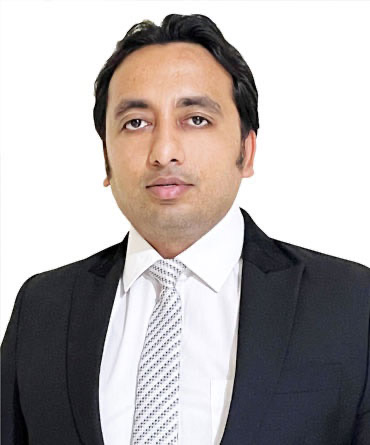
India’s USD 15 Trillion Mission
Mr. Digant Sharma is an entrepreneur, social architect and nation-building strategist whose work spans technology, agriculture, finance, digital governance, social welfare, corporate social responsibility, media and institutional development.
His central interest is structural rather than sectoral. The question he returns to is how large populations that operate outside formal economic systems can be brought into them in a way that is practical, dignified and durable. That question connects fields that look separate from the outside: a technology platform, an agricultural supply chain and a welfare programme are, from this perspective, three views of the same problem.
The method is institutional. Build the mechanism, document it, and make it operable by people other than its founder. An initiative designed to depend on one individual does not survive that individual, which is a poor design for anything intended to change a system.
SAKSHAM is the initiative most closely associated with his name. Its stated objective is the formalisation of India's informal economy: bringing unrecorded economic activity, and the people who conduct it, into recognised financial, tax and administrative systems.
The stated ambition is framed around India's long-term economic trajectory and a USD 15 trillion economic mission. The reasoning behind it is that informality imposes a compounding cost — on the individual, who cannot readily access credit, insurance or protections; and on the state, whose planning and revenue base rest on incomplete information. On this argument, formalisation is not primarily a revenue exercise but an inclusion exercise.
Much of this work is pursued through Torus Innotech Pvt Ltd and associated foundations, which serve as the delivery and outreach structures for initiatives spanning technology platforms, agricultural and rural programmes, financial-access work, digital governance, welfare and corporate social responsibility.
The recurring pattern is to treat an organisation as an instrument rather than an identity: a structure built for a specific function, staffed and documented so that the function continues when circumstances change.
Technology is applied as infrastructure rather than as a product in its own right. Platforms for registration, record-keeping, financial access and digital governance are approached as the means by which a person without formal documentation becomes visible to the systems that are supposed to serve them — which is a design problem before it is an engineering one.
The work described has been pursued across a number of locations in India, including in Maharashtra — among them Nanded, Kinwat and Mahur — and in Odisha, alongside other locations. In these settings the emphasis has been on agriculture and rural livelihoods, financial inclusion, access to digital services, welfare delivery and corporate social responsibility programmes.
These are described here as his civil, entrepreneurial and social-development activities and as stated objectives of the initiatives concerned. They are not presented as completed outcomes, official programmes, or activities of this security organisation.
Statement of record
Mr. Digant Sharma is the contact for enquiries to this organisation. The initiatives described above are his civil, entrepreneurial and social-development work. Their inclusion here does not constitute a government endorsement of this organisation, nor does it indicate any governmental, military, intelligence or law-enforcement office, rank, appointment or authority. He is not described, and must not be understood, as a military officer, a Special Frontier Force officer, an intelligence officer, an Indian Army officer or a government officer. He does not hold, and this website does not claim for him, any such position.
Next step
We will tell you what is possible, what is not, and what would have to be true before anything could proceed.